Category: Thought Leadership

  • Most Recruiting and Staffing Companies Are Missing This AI Shift

    Most Recruiting and Staffing Companies Are Missing This AI Shift

    I noticed something yesterday that recruit and Staffing professionals can’t afford to ignore. ChatGPT just hit 150 million weekly active users – a 5% jump in just one week. But the real story isn’t about OpenAI’s growth; it’s about what this accelerating AI adoption means for your recruitment marketing strategy.

    This isn’t random growth. The surge came specifically from users flocking to try ChatGPT’s new image generation capabilities. People are creating Studio Ghibli-inspired art in seconds, straining OpenAI’s servers in the process.

    Why should you care?

    Because it signals a fundamental shift in how people are interacting with AI – from passive consumption to active creation. And most recruitment agencies are completely unprepared for what this means.

    The Generative AI Explosion

    I’ve been in this industry long enough to witness several technological transitions. I watched the yellow pages become obsolete as the internet took over. Now I’m watching traditional recruitment marketing approaches fade as AI CRM’s with AI agents reshapes everything.

    The numbers tell the story. Global app downloads for ChatGPT jumped 11% while in-app subscription revenue climbed 6%. People aren’t just trying AI – they’re paying for it. They’re integrating it into their workflows. They’re becoming dependent on it.

    Your candidates and clients are among them.

    When I started implementing AI tools in real-world sales and recruitment roles, I immediately saw how they enhanced client qualification and candidate screening efficiency. The manual workload dropped. Selection accuracy improved. But that was just the beginning.

    The New Recruitment Marketing Reality

    The recruitment agencies thriving today are the ones that understand a crucial truth: AI isn’t just another tool – it’s becoming the central nervous system of effective recruitment marketing.

    Consider what’s happening with ChatGPT’s image generation capability. Users can now create visual content that would have required a designer just weeks ago. This same pattern is playing out across the recruitment marketing landscape.

    Job descriptions, candidate outreach, market analysis – these traditional recruitment marketing tasks are being transformed by generative AI tools. The agencies that embrace this shift gain an exponential advantage.

    I’ve seen firsthand how properly implemented AI in recruitment can transform a recruiting firm’s marketing capabilities:

    Candidate engagement increases when outreach is personalized at scale. Market positioning improves with data-driven content strategy. Talent acquisition accelerates through predictive analytics and automated nurturing.

    The Hybrid Approach That Actually Works

    The most successful implementation I’ve witnessed comes from what I call the Hybrid AI Workforce Approach – merging human intuition with AI capabilities.

    This isn’t about replacing recruiters. It’s about empowering them.

    When I developed our comprehensive Sales and Recruitment Engine Framework, I specifically designed it to address the challenges of today’s cutthroat sales environment and persistent talent shortages. The key was optimizing each stage of the recruitment process through strategic AI in recruitment implementation.

    The agencies seeing the greatest returns aren’t just bolting on generic AI tools. They’re integrating purpose-built AI agents directly into their CRM and business workflows. These aren’t chatbots – they’re intelligent, task-specific digital workers trained to qualify leads, schedule appointments, and drive deals through your sales funnel.

    Some recruitment marketing functions can be fully automated. Others require that critical human touch. Understanding which is which makes all the difference.

    What This Means For Your Agency

    The surge in ChatGPT usage represents a broader trend that recruitment agencies can’t ignore. AI adoption isn’t slowing – it’s accelerating. The competitive gap between AI-Powered Staffing agencies and traditional operations is widening daily.

    But there’s good news.

    You don’t need massive resources to implement effective AI in your recruitment marketing. Small and mid-sized agencies actually have an advantage in agility and speed of adoption.

    Start by identifying your most time-consuming, repetitive marketing tasks. These are prime candidates for AI recruitment automation. Then look at your highest-value creative work that could benefit from AI augmentation rather than replacement.

    The legal questions around AI-generated content that the article mentions – particularly around copyright – are legitimate concerns. But they shouldn’t prevent forward-thinking implementation. Focus on augmenting your team’s capabilities rather than simply generating content without oversight.

    Moving Forward

    Every major technological shift creates winners and losers in our industry. I watched it happen when the internet transformed recruitment. I’m watching it happen again with AI.

    The 150 million weekly ChatGPT users represent more than just a statistic. They reveal how quickly AI is becoming integrated into everyday workflows. Your clients and candidates are among those users, and their expectations are evolving accordingly.

    The question isn’t whether AI will transform recruitment marketing. It’s whether your agency will be among those leading the transformation or scrambling to catch up.

    The agencies that thrive will be those that develop a clear AI strategy aligned with their business goals, curate the right tech stack without unnecessary fluff, integrate AI capabilities directly into existing infrastructure, and follow clear execution playbooks that track ROI.

    The time for tentative experimentation has passed. The 150 million weekly ChatGPT users have spoken. AI is here, it’s growing, and it’s changing recruitment marketing forever.

    The only question is whether you’ll be part of that change or left behind by it.

  • AI Weakens Critical Thinking Unless You Do This

    AI Weakens Critical Thinking Unless You Do This

    I’ve been watching the AI revolution transform business for years now, but a recent study from Carnegie Mellon and Microsoft has confirmed something I’ve suspected all along: our increasing reliance on AI might be compromising our ability to think critically.

    As someone who has built a business around integrating AI into recruitment and sales  processes, this research hit close to home. It found that people who trust AI systems tend to engage less critically with the outputs these systems generate. They essentially outsource their thinking to the algorithm.

    This shift isn’t subtle. The researchers observed a fundamental change from task execution to mere oversight when people use generative AI. Efficiency improves, but at what cost?

    The Hidden Danger Behind AI Efficiency

    The study revealed something fascinating. People who were more skeptical of AI actually demonstrated better critical thinking skills when reviewing AI outputs. Their skepticism triggered deeper cognitive engagement.

    This matters enormously in recruitment and sales.

    When a sales person or recruiter accepts an AI-generated customer or candidate assessment without question, they’re not exercising the judgment that makes human valuable in the first place. They’re becoming operators rather than thinkers.

    I’ve seen this happen firsthand. Teams get so comfortable with AI handling candidate screening that they stop questioning the parameters and assumptions built into the system. The initial efficiency gain eventually leads to intellectual complacency.

    The Cognitive Offloading Problem

    What we’re experiencing is cognitive offloading on an unprecedented scale. We’ve always used technology to extend our capabilities, but generative AI doesn’t just extend our thinking—it can gradually replace it if we’re not careful.

    Consider what happens when you rely completely on GPS. Your natural navigation skills deteriorate. The same principle applies with AI in professional settings. When the machine thinks for you, those mental muscles atrophy.

    For recruiters, this could mean diminished ability to spot nuances in customer or candidate potential, reduced capability to connect disparate skills to organizational needs, and weakened instincts about cultural fit.

    The Hybrid AI Workforce Solution

    After years of implementing AI in sales and recruitment settings, I’ve developed an approach that preserves critical thinking while capturing efficiency gains—what we call the Hybrid AI Workforce model.

    This isn’t just theoretical. It’s the cornerstone of how we structure AI implementation at AI Powered Staffing.

    The key principle is straightforward: AI should handle tasks, not decisions. When we implement AI Agent Teams for our clients, we deliberately design interaction points that require human critical assessment.

    For example, our AI can efficiently screen resumes against job requirements, but the human recruiter must then critically evaluate the AI’s reasoning before moving candidates forward. This creates a crucial checkpoint for human judgment.

    Building Critical Thinking Into AI Workflows

    The beauty of this approach is that it turns AI into a critical thinking enhancer rather than a replacement. Here’s how we structure it:

    First, we identify which sales and recruitment tasks benefit from AI automation. Typically these include initial screening, basic sales and candidate communications, and sales call or interview scheduling.

    Next, we deliberately design “cognitive checkpoints” where human sales and recruiters must engage with the AI’s reasoning, not just its conclusions. This forces critical evaluation rather than passive acceptance.

    Finally, we implement feedback loops where human insights improve the AI, creating a virtuous cycle where human critical thinking constantly refines the system.

    This approach maintains the efficiency benefits of AI while actively preserving and even enhancing human critical thinking skills.

    The Future Belongs to Balanced Implementation

    The Carnegie Mellon/Microsoft research should serve as a warning, not a deterrent. AI in recruitment and sales isn’t going away—nor should it. The efficiency gains are too valuable to abandon.

    The recruitment firms that will thrive in this new environment are those that implement AI with intentional balance. They’ll use AI to handle the mundane while ensuring their human team members continue exercising their unique cognitive abilities.

    This is why I’m so passionate about our Fractional Chief AI Officer service. We don’t just drop AI tools into existing workflows and hope for the best. We architect systems that intentionally preserve human critical thinking while capturing AI efficiency.

    The research is clear: passive reliance on AI weakens critical thinking. But with thoughtful implementation, AI becomes not just a productivity tool but a catalyst for better human decision-making in recruitment.

    The future of recruitment isn’t AI or human intelligence. It’s both, working in deliberate harmony.

  • AI Sales Agents Are Crushing Human Sales Teams

    AI Sales Agents Are Crushing Human Sales Teams

    I watched my yellow pages sales career vanish when the internet arrived. Now, I’m seeing the exact same pattern unfold in staffing and recruiting sales – but at five times the speed.

    The signs are everywhere. Small and regional recruiting firms with AI-enhanced sales teams are outperforming larger agencies relying solely on human effort. The math is becoming undeniable.

    While most of the industry debates whether to dip their toes into AI, the early adopters I work with are already seeing 3-5x output from their sales teams without adding headcount. This isn’t theoretical – it’s happening right now.

    Why Traditional Sales Is Dying

    Let’s face it. The traditional sales model is fundamentally broken.

    Your sales people spend hours each day on low-value activities: manual data entry, repetitive follow-ups, and endless email management. They’re drowning in administrative work instead of building relationships with clients and candidates.

    I remember walking into a staffing firm last year and watching their top biller spend nearly 70% of her day on tasks that had nothing to do with actual selling or recruiting. When I pointed this out, her response was telling: “That’s just how it is.”

    But that’s not how it has to be.

    What AI Sales Agents Actually Do

    The game-changer isn’t chatbots or generic AI tools. It’s purpose-built AI sales agents integrated directly into your CRM and business workflows.

    These aren’t futuristic concepts. They’re operational today.

    I’ve watched AI sales agents qualify leads, schedule appointments, personalize outreach, and nurture relationships – all without a human lifting a finger. When properly trained on your sales process, they operate 24/7 with superhuman consistency.

    One mid-sized staffing firm we work with has AI agents that conduct the first three touches with every inbound lead. Only qualified opportunities ever reach a human salesperson. Their team now focuses exclusively on high-value conversations while their pipeline has grown by 340%.

    The Hybrid Workforce Model

    The most successful implementations aren’t about replacing humans – they’re about strategic collaboration between AI and your team.

    I call this the Hybrid AI Workforce model. It’s not about eliminating jobs; it’s about eliminating the soul-crushing parts of jobs that drive burnout and turnover.

    When I first started experimenting with this approach, I was skeptical. Could AI really handle the nuanced communication needed in sales?

    What I discovered surprised me. AI excels at consistency, persistence, and data-driven decision making – precisely where human salespeople typically struggle. Meanwhile, humans still dominate at building deep relationships, handling complex objections, and closing deals.

    The magic happens when you combine both strengths.

    What This Means For Your Recruiting Firm

    The implications are profound, especially for small and mid-sized firms.

    For the first time, you can compete with larger agencies without matching their headcount. Your team of 10 can operate with the output capacity of 30-50 through strategic AI sales deployment.

    But there’s a closing window of opportunity. The competitive advantage is strongest for early adopters.

    I’ve seen firms implement properly configured AI sales agents and experience immediate results:

    – Sales cycles shortened by 40-60%
    – Lead response times reduced from hours to seconds
    – Follow-up consistency approaching 100%
    – Sales team capacity expanded by 3-5x without adding headcount

    And the firms seeing these results aren’t tech giants. They’re regional staffing companies with 5-50 employees who simply made the decision to move while their competitors deliberated.

    The Hard Truth About Implementation

    Despite the compelling case, most staffing firms will fail at AI sales implementation. Not because the technology isn’t ready, but because they approach it incorrectly.

    The biggest mistake I see is treating AI as a technology project rather than a strategic business initiative. Downloading ChatGPT and expecting magic is like buying a treadmill and expecting to wake up fit.

    Successful implementation requires:

    1. A clear understanding of your existing sales process
    2. Strategic decisions about which parts to automate versus augment
    3. Proper integration with your sales data
    4. Continuous optimization based on performance data

    This is precisely why we developed the Fractional Chief AI Officer service. Most staffing firms need strategic guidance, not just tools.

    The Question Isn’t If, But When

    I’ve been in this industry long enough to recognize inflection points. This is one of them.

    The firms that deploy AI sales agents effectively in the next 12-18 months will create an advantage that latecomers may never overcome. Their cost of customer acquisition will be lower. Their speed to market will be faster. Their sales teams will be happier and more productive.

    Those who wait for perfect clarity before acting will find themselves in the same position as yellow pages salespeople in 2005 – watching their business model evaporate as the world moves on.

    The most successful leaders I work with aren’t asking whether to adopt AI in their sales function. They’re asking how quickly they can implement it while their competitors remain stuck in deliberation.

    The question isn’t whether AI will transform your sales operations.

    It’s whether you’ll be leading that transformation or scrambling to catch up.

  • College AI Strategy Creates Recruiting Challenge

    College AI Strategy Creates Recruiting Challenge

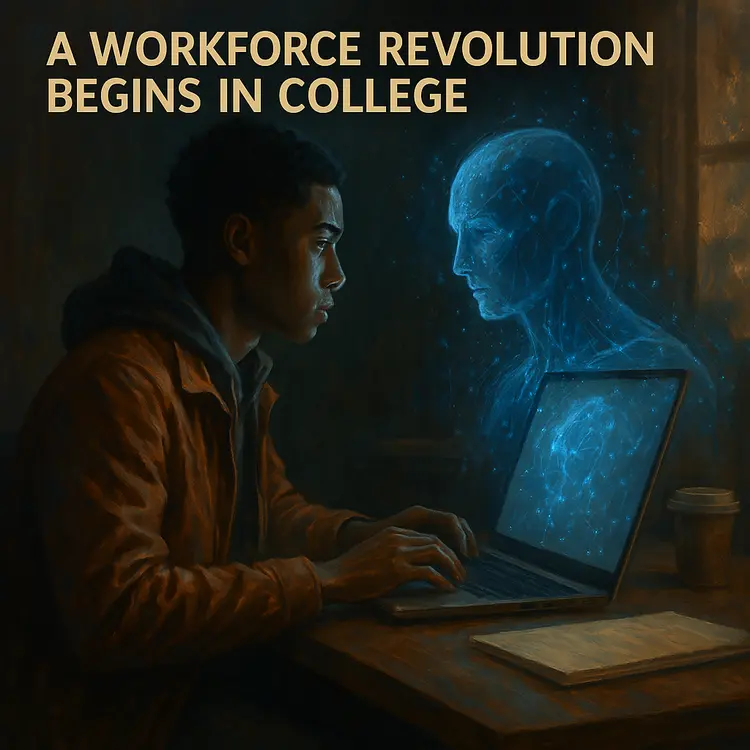
    I’ve watched AI transform recruiting for years now, but OpenAI’s latest move feels different. Their decision to offer ChatGPT Plus free to college students until May 2025 isn’t just another tech giveaway. It’s the beginning of a workforce revolution that will fundamentally reshape how we recruit, hire, and work.

    The strategy is brilliant. By giving students access to premium features like GPT-4o, voice interaction, and image generation, OpenAI isn’t just being generous. They’re creating an entire generation of professionals who will graduate expecting advanced AI tools in every aspect of their careers.

    I saw this pattern before. When I started in recruiting after my sales and marketing days, CRM systems were optional. Then suddenly, they weren’t. Companies that failed to adopt them quickly became dinosaurs. AI is following the same trajectory, but at hyperspeed.

    The Literacy Gap Is About To Close

    For years, I’ve helped staffing and recruiting firms implement AI solutions. The biggest obstacle has never been the technology itself but the comfort level of users. OpenAI just eliminated that barrier for an entire generation.

    Think about it. College students using GPT-4o to draft emails, analyze research papers, prepare presentations, and navigate complex concepts won’t just become comfortable with AI.

    They’ll become fluent.

    When these students graduate, they won’t ask if your recruiting firm uses AI tools. They’ll ask which ones. And if your answer is “none” or “basic,” you’ll instantly seem outdated.

    This creates an urgent need for what we call the Hybrid AI Workforce model – where AI and human capabilities merge to create something greater than either could achieve alone. Staffing and recruiting firms that don’t adopt this model will struggle to connect with the next generation of talent.

    Preparing For The AI-Native Candidate

    I’ve implemented AI tools in real-world recruitment settings for years now. The difference between today’s professionals gradually adapting to AI and tomorrow’s graduates who’ve never known work without it will be stark.

    These AI-native professionals will:

    Evaluate potential employers based on their AI sophistication. They’ll judge your candidate experience against their experiences with advanced AI tools in college.

    Approach problem-solving differently, leveraging AI as naturally as previous generations used calculators or spreadsheets.

    Expect AI-enhanced communication throughout the recruitment process, from initial outreach to onboarding.

    Working with hundreds of staffing and recruiting firms, I’ve noticed those who thrive aren’t necessarily the ones with the biggest budgets. They’re the ones who adapt fastest. OpenAI’s student strategy accelerates the timeline for that adaptation.

    The Future Belongs To Hybrid Workforces

    The converging forces of AI-trained graduates and increasingly sophisticated AI tools point to one conclusion: the future belongs to hybrid AI workforces where human intuition and AI capabilities complement each other.

    For recruiting firms, this means:

    Integrating AI into your workflow isn’t optional – it’s existential. The gap between AI-enabled firms and traditional operations will widen dramatically as AI-fluent candidates enter the workforce.

    Training your current team on AI tools isn’t just about productivity. It’s about speaking the same language as your future clients and candidates.

    Developing a Hybrid AI Workforce strategy now gives you time to experiment, learn, and optimize before the wave of AI-native graduates hits the market.

    When I first explored AI and automation as solutions to recruitment challenges, many viewed it as experimental. Today, it’s becoming standard. Tomorrow, it will be the baseline expectation.

    The Strategic Move For Recruiting Firms

    OpenAI’s strategy reveals the playbook for forward-thinking recruiting firms. By giving students free access, they’re building loyalty that will translate into workplace advocacy. Smart recruiting firms should follow suit.

    Start building your AI capabilities now. Focus on creating systems where AI handles repetitive tasks while your human team focuses on relationship building and strategic thinking.

    Document your AI implementation journey. When AI-native candidates ask about your technological sophistication, you’ll have concrete examples of how you’ve embraced these tools.

    Develop expertise in matching AI-savvy candidates with employers ready for their skills. This specialization will become increasingly valuable as the talent market evolves.

    I’ve seen firsthand how AI can transform recruitment when implemented thoughtfully. The firms that thrive won’t be those who resist change or adopt AI haphazardly. They’ll be the ones who develop comprehensive strategies for integrating human and artificial intelligence.

    OpenAI’s student initiative isn’t just about giving free tools to cash-strapped college kids. It’s about reshaping expectations for an entire generation of professionals. For recruiting firms, the message is clear: adapt to the hybrid AI workforce model now, or risk becoming irrelevant to tomorrow’s talent.

    The challenge is real. But so is the opportunity. The question isn’t whether AI will transform recruiting – it’s whether your firm will lead that transformation or be left behind.

  • AI Recruitment Revolution Demands Human Evolution

    Test Gadget Preview Image

    AI tools transform. Humans adapt. Recruitment thrives.

    The recruiting and staffing industry stands at a pivotal crossroads. Traditional methods that once defined our profession now struggle to keep pace with market demands. The integration of artificial intelligence isn’t merely an option anymore – it’s becoming the differentiator between agencies that scale and those that stagnate.

    What’s fascinating about this shift isn’t the technology itself but how it redefines the human element in recruitment. AI doesn’t replace recruiters; it elevates them from administrative processors to strategic talent advisors. This transformation requires a fundamental rethinking of skills, processes, and value propositions.

    The most successful staffing firms today are adopting a hybrid approach. They leverage AI for candidate screening, engagement automation, and predictive analytics while focusing human expertise on relationship building, cultural assessment, and strategic consultation. This balance creates a powerful synergy that neither humans nor AI could achieve independently.

    Data now shows that agencies implementing AI-driven recruitment processes see up to 3x improvement in candidate matching accuracy and significant reductions in time-to-hire. But the technology alone isn’t enough. The critical factor is how organizations integrate these tools into their existing workflows and upskill their teams to leverage AI insights effectively.

    Looking forward, the recruitment industry won’t be divided between AI adopters and non-adopters. The distinction will be between those who use AI strategically to enhance human capabilities versus those who implement technology without reimagining their core processes.

    For staffing professionals navigating this transition, the focus should be on developing complementary skills that AI cannot replicate: emotional intelligence, strategic thinking, and consultative selling. The future belongs to recruiters who can interpret AI insights and translate them into meaningful business outcomes for clients and candidates alike.

    The AI revolution in recruitment isn’t about replacing humans. It’s about creating a new paradigm where technology handles the routine while humans deliver unprecedented value through judgment, intuition, and relationship building. This is the next evolution of our industry, and it’s happening now.

  • AI Transforms Recruiting Beyond Recognition

    Test Gadget Preview Image

    Talent finds new paths. The recruitment industry stands at a crossroads unlike any we’ve seen before. Artificial intelligence isn’t just another tool in our arsenal – it’s fundamentally reshaping how we connect talent with opportunity.

    Having witnessed the evolution of recruitment firsthand, I’ve observed persistent inefficiencies that plague traditional hiring processes. Manual screening consumes countless hours. Candidate engagement falters. Sales cycles stretch too long. These challenges aren’t new, but our ability to solve them has dramatically advanced.

    The transformation begins with understanding that AI serves as more than automation. It functions as an intelligent partner across your entire operation. When properly implemented, AI enhances human capabilities rather than replacing them, creating what I call a Hybrid AI Workforce.

    The Four Pillars of AI Recruitment Transformation

    Successful implementation requires focus on four core business functions. First, sales acceleration through AI qualification and engagement tools that identify promising clients before your competitors. Second, marketing automation that delivers personalized outreach at scale without sacrificing authenticity. Third, candidate sourcing and screening that finds hidden talent while eliminating bias. Fourth, support systems that maintain relationships through intelligent, contextual communication.

    What makes this approach powerful isn’t each component in isolation. The magic happens at their intersection.

    Consider what happens when your AI recruitment system identifies a qualified candidate and simultaneously alerts your sales team to a client with matching needs. This coordination creates opportunity that manual processes simply cannot match in speed or precision.

    Leveling the Playing Field

    Small and mid-sized staffing firms traditionally operate at a disadvantage against corporate giants with massive resources. AI fundamentally changes this equation. The technology allows boutique operations to deliver enterprise-level service without enterprise-level headcount.

    One regional staffing firm implemented our CRM-integrated AI Agent Teams and saw their candidate screening capacity triple while reducing time-to-placement by 40%. Their team size remained unchanged, but their capabilities expanded dramatically.

    This isn’t theoretical potential. It’s practical application delivering measurable results.

    Building Your AI Recruitment Strategy

    Start by examining your current workflow. Where do your recruiters spend most of their time? Which tasks require human judgment and which could benefit from automation? The answers create your roadmap.

    Avoid the common mistake of implementing disconnected tools. An integrated approach connecting your CRM with purpose-built AI agents delivers exponentially better results than standalone solutions.

    Remember that implementation succeeds through strategic planning rather than technological sophistication. The best technology applied without clear business objectives creates impressive demonstrations but disappointing outcomes.

    The staffing and recruitment industry stands at the beginning of its most significant transformation. Those who embrace AI strategically will thrive. Those who wait will struggle to catch up.

    Your competitive advantage awaits not in some distant future but in decisions you make today about how technology augments your team’s capabilities. The question isn’t whether AI will transform recruitment, but whether you’ll lead that transformation or follow others who do.